Matter, Thread, and the Smart Home That Was Supposed to Fix Everything

(But Mostly Just Broke What Already Worked)
For years, my smart home ran on Zigbee. IKEA sensors, switches, remotes, lights — plus a handful of other brands — all quietly doing their job. No drama. No cloud dependency. No “commissioning rituals.” No “please sign in to your vendor account so you can turn on your own lamp.” Just a mesh network that worked.
Sure, a few bargain‑bin devices from Shenzhen occasionally acted like they’d never seen a radio before, but once they were properly paired, they behaved. Zigbee wasn’t perfect, but it was predictable. Stable. Local. And most importantly: mine.
Then came Matter over Thread — the “future of smart home,” the “industry‑wide standard,” the “one protocol to unite them all.” And IKEA, bless their optimistic hearts, bet big on it. Which meant I was effectively forced to “upgrade.”
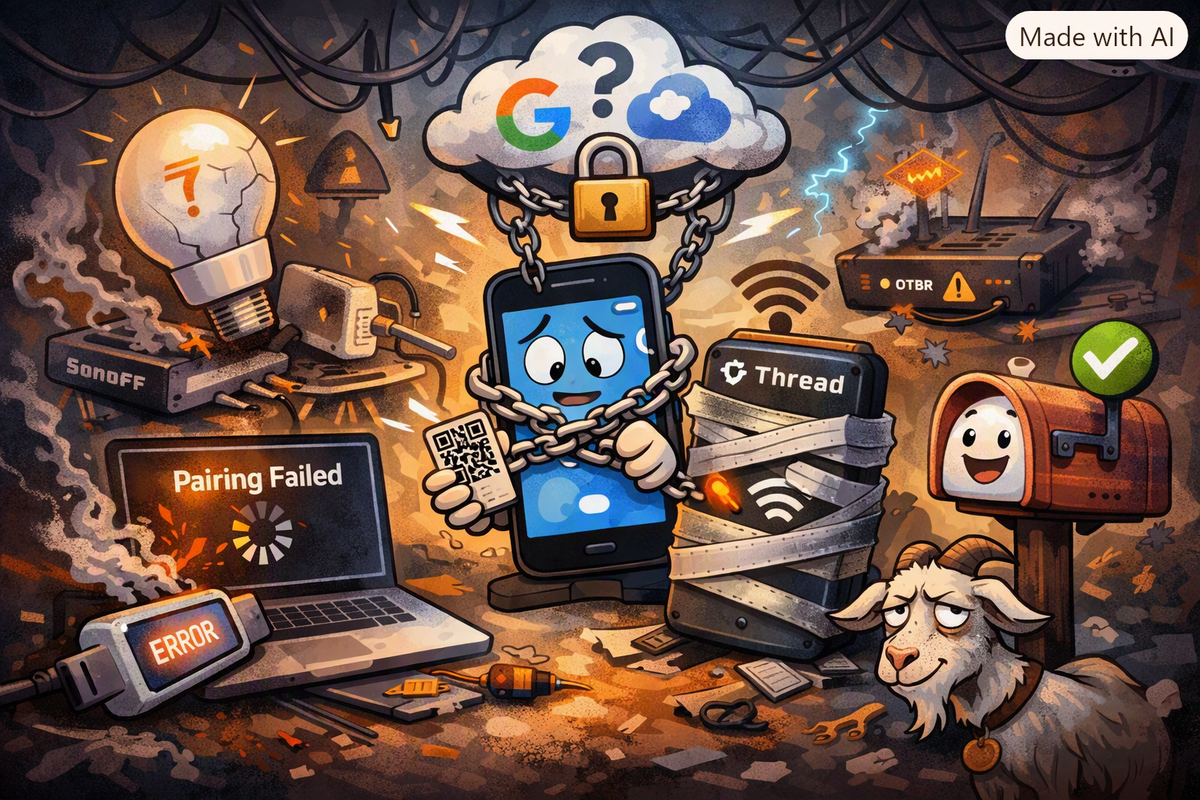
So I added a Sonoff Thread/Matter USB stick, OTBR, and the rest of the Thread ecosystem to Home Assistant. And immediately nothing would pair. At all. Which, judging from everyone else’s experience, is basically the official Matter onboarding ritual.
The Phone Problem: Why Do I Need a Smartphone to Add a Light Switch in My Own House?
Here’s the part that still blows my mind:
To add a Matter device to my own Home Assistant instance, running on my own hardware, inside my own house, on my own network… I need a phone.
Not “a phone is convenient.”
Not “a phone makes it easier.”
No — a phone is required!
Matter’s commissioning process is built around the assumption that every household has a smartphone acting as the sacred ceremonial priest who blesses new devices before they’re allowed to exist on your network. It’s the digital equivalent of needing a notary public to plug in a lamp.
And sure, everyone and their dog does have a phone these days — usually several — but that’s not the point. The point is:
Why does a supposedly local, open smart‑home standard require a cloud‑connected smartphone to approve devices inside my own property?
🧠 What the phone actually does
Your phone isn’t just “helping.” It’s doing all the heavy lifting:
- It scans the QR code to retrieve the vendor‑specific commissioning payload.
- It contacts the vendor’s cloud to validate that payload.
- It uses BLE to talk to the device.
- It uses Wi‑Fi to talk to Home Assistant.
- It uses IPv6 multicast to talk to the Thread Border Router.
- It uses vendor cloud endpoints to confirm device type, capabilities, and security keys.
- It hands off the Thread dataset to OTBR.
- It finally tells Home Assistant, “Okay, you may now speak to your own device.”
If any one of those steps fails — cloud unreachable, BLE flaky, Wi‑Fi isolated, IPv6 filtered, QR code misread — commissioning dies.
This is why Matter pairing feels like a ritual.
Your phone is the high priest, and the cloud is the deity.
Home Assistant is just the peasant waiting for permission.
Why this design is fundamentally flawed
Matter’s “local first” promise collapses the moment you realize:
- You cannot add a device without a phone.
- You cannot add a device without the vendor’s cloud being online.
- You cannot add a device without your phone being on the correct Wi‑Fi network.
- You cannot add a device if your phone can’t reach the Thread Border Router.
- You cannot add a device if your phone’s BLE stack is having a bad day.
Zigbee never needed any of this.
You put the device in pairing mode, Home Assistant sees it, and boom — done.
Matter requires a smartphone ceremony, a cloud blessing, and a network topology that looks like a corporate office.
The irony
Matter was supposed to be the standard that finally unified everything.
Instead, it unified one thing:
Everyone’s shared frustration that adding a smart‑home device now requires more steps than filing taxes.
The Network Handshake From Hell
Thread’s design is theoretically elegant. In practice, it’s like every device needs a VIP wristband to three different backstage areas, and none of the bouncers speak the same language.
- Your phone needs to reach one special network.
- OTBR needs to reach two different networks.
- Home Assistant needs to reach all of them plus Google and whatever other cloud deity Matter feels like consulting.
- Multicast must work.
- IPv6 must work.
- BLE commissioning must work.
- Vendor cloud endpoints must be reachable.
- And all of this must happen simultaneously.
If any part fails, pairing dies silently. No logs. No errors. Just “device offline.”
So, I finally shoved HA, OTBR, and the Thread stack into their own VLAN, because apparently that’s the modern equivalent of sprinkling holy water on the router. And sure enough, things started working.
For about 48–72 hours.
Then — just like everyone else reports — everything goes offline at the worst possible moment. I reboot HA, restart OTBR, sacrifice a goat, whatever… and it comes back. Until it doesn’t. And the cycle repeats.
Zigbee: The “Old” Tech That Still Outperforms the “Future”
So much for “the future of smart home.” The range is laughable compared to Zigbee, the stability is somewhere between “beta software” and “held together with duct tape,” and the whole thing feels like a product that escaped the lab before anyone bothered to test it outside a Silicon Valley conference room.
Meanwhile Zigbee — the supposedly “old” tech — just sits there quietly doing its job, covering your entire house (and in my case, even the outside property — I’ve got door sensors in the mailboxes telling me when the post has been delivered, for god’s sake; try that with a Thread device), never demanding special networks, never needing cloud blessings, and never deciding to go offline because it’s Tuesday.
It’s almost impressive how Matter managed to be newer, more complicated, and worse at the one thing Zigbee has nailed for over a decade: simply working.
Where This Leaves Us
Matter isn’t doomed. Thread isn’t doomed. But right now, the “future of smart home” feels like a future where:
- You need cloud approval to pair local devices.
- You need multiple border routers to maintain a single mesh.
- You need VLANs to keep the commissioning stack from imploding.
- You need to reboot things weekly.
- And you need patience measured in geological time.
Zigbee didn’t need any of that.
Zigbee just worked.
Matter could get there someday — but today, it’s a science experiment pretending to be a standard.